



EXPLORE Act Focuses on Making Outdoors More Accessible
Last year, the EXPLORE Act became law, making it the most comprehensive outdoor recreation legislation in history. A core component of the law requires federal land agencies to develop accessible trails and recreation opportunities across National Park Service, Forest Service, Fish & Wildlife Service, and Bureau of Land Management lands.
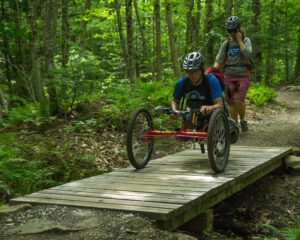
The Accessibility Coalition, made up of companies, national nonprofits, local user groups, and others focused on building out accessible outdoor places, conducted a national survey of 120 organizations to recommend trails and recreational opportunities to the accessibility programs of the National Park Service, Forest Service, Fish and Wildlife Service, and Bureau of Land Management to help inform their decisions.
To support implementation, the Accessibility Coalition gathered 145 recommendations from 120 organizations in 37 states, to identify high-impact, scalable projects ready for action. Move United, a proud member of the coalition, took part in a report recommending which trails and recreation opportunities should be included in the agencies’ implementation plan.
This report reflects a truly collaborative effort:
- 145 survey responses
- 120 unique organizations (many are Move United members)
- 140 individuals
- Projects spanning 37 states
Together, we identified priority projects and scalable models to help agencies meet the EXPLORE Act’s requirement to designate at least 3 accessible trails and 2 accessible recreation opportunities per region within seven years.
The findings highlight:
- High-priority, construction-ready projects serving 500+ individuals annually
- Opportunities to modernize trail surfaces, signage, and interpretation
- Expanded access to camping, water access, adaptive biking, snow sports, climbing, and sensory recreation
For visitors with disabilities, a number of challenges impact their ability to access America’s public lands. Much of the federal public land infrastructure – trails, facilities, campgrounds, visitor centers, and program spaces – was built long before modern accessibility standards existed, resulting in physical environments that are difficult or impossible for many people with mobility, sensory, or cognitive disabilities to use. Even when accessible features are available, visitors often cannot reliably find accurate, detailed, or accessible information about them, creating significant informational barriers that prevent many from planning or attempting a visit.
Click here to see the full report. As we move forward, we are excited to work with our federal partners to translate these recommendations into durable access for all.
Share


