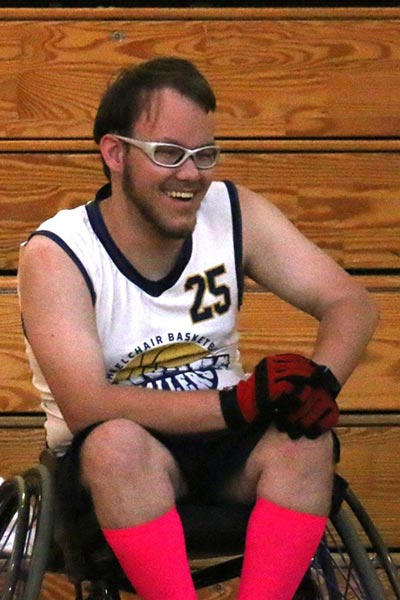




Jeremy Boyd
"Tennis did a big thing to help save my life and get me on a healthy track and make me want to do more with my life than just sitting around." - Jeremy Boyd
Boyd grew up playing baseball and football, competing through high school at Hoover High School in Alabama where he learned to push beyond his limits and dedicate himself to his craft. He continued playing football into his freshman year of college before deciding to pursue a different path.
On December 8, 2016, Boyd was shot, sustaining an incomplete spinal cord injury at his L3 vertebrae. After three weeks in the hospital, he moved to Tuscaloosa to live with his brother's family and begin rehabilitation.
A chance encounter at a farmers market changed everything. Wheelchair tennis players Shelby Baron and Lauren Haneke-Hopps invited Boyd to try the sport. Though hesitant at first, Boyd fell in love with tennis the moment he hit the court at a community clinic. The sport gave him an outlet and a path forward, opening up a world where he could still compete at the highest level.
Boyd now competes in the Men's A division, the highest level of wheelchair tennis. He plays for the University of Alabama's adaptive athletics program, which won the collegiate wheelchair national championship in April. Boyd trains intensively—three strength and conditioning sessions plus five court practices each week—constantly refining his game through repetition and strategy.
His approach to competition has evolved from pure athleticism to mental chess. Boyd focuses on outthinking opponents and controlling what he can on the court. Chair skills matter as much as tennis technique, and he emphasizes the grinding work of refinement that defines elite competition.
The Paralympics remain firmly in Boyd's sights. He is working toward representing Team USA in Paris or the next Games, putting in the hours and asking himself daily how badly he wants it.
Off the court, Boyd is completing his senior year at the University of Alabama, majoring in African American Studies. He is considering pursuing a PhD and becoming a professor, inspired by the mentors who shaped his worldview.
Boyd refuses to accept limitations others might place on him. He measures himself by his own standards, not by expectations of what someone with a disability should or shouldn't achieve.