



Gary Kerr
Competition | 1996
Hometown: Lake Oswego, Oregon
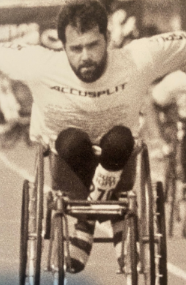
A member of nine USA international teams, Gary is credited by many as one of the athletes whose experimentation with old-fashioned everyday wheelchairs helped to initiate the transformation to today’s racing wheelchair designs.
The design of racing wheelchair went unchanged from 1956 to 1975 due to rules that severely restricted any alterations to the basic, fourwheel everyday chair used in competition. Gary, along with DeAnza College teammates Rod Williams and Steve Scott, made changes to their chairs that the rules did not specifically address and ultimately
helped to revolutionize the sport of wheelchair racing. While training for competitions in the mid-70’s, the three men started to experiment with their wheelchairs using different sized handrings, loosening the upholstery as well as raising the footplates to alter the position of their bodies in the chair. This prompted the National Wheelchair
Athletic Association to revise many of these antiquated restrictions.
Once in his chair, Gary showed the ability to race effectively at all distances. He was a dominant force in the Class II division throughout the 70’s and 80’s. In 1983 Gary became the first American athlete to break the four minute barrier in the mile and the following year set the national record in the 10K distance. He had the fastest 1500 meter time in the world going into the exhibition 1500 meter race at the 1984 Olympic Games in the Coliseum in Los Angeles.


