



Christa Zander Welger
1986
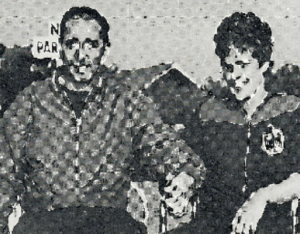
Christa Zander began her extraordinary wheelchair sports career in 1957 as a member of the German National Team. A year later, at the 1958 Stoke Mandeville Games, she captured three first-place finishes in swimming and gold medals in javelin, shot put, and club throw. In 1959, she returned to Stoke Mandeville and repeated all six of her gold medal performances—adding yet another in precision javelin.
At the 1960 Paralympic Games in Rome, it was the Christa Zander show. She claimed seven gold medals, each one setting a new Paralympic record, and added a silver medal in archery. Her dominance made her the toast of the Paralympic Village and firmly established her as the greatest female wheelchair athlete in the world at that time. Christa continued her record-breaking ways in 1961, setting several new world records.
During her international travels, Christa met Saul Welger, a young American athlete, at the 1958 Stoke Mandeville Games. Their long-distance relationship quickly became one of the most celebrated romances in the wheelchair sports world, culminating in marriage in June 1962.
Christa arrived in New York City on June 15, 1962, and—remarkably—competed the very next day in the U.S. National Wheelchair Games. On her first full day in the United States, she won javelin, discus, shot put, and table tennis, an incredible debut that made history. That same year marked the first time women were allowed to compete in the National Wheelchair Games, and Christa’s records became the benchmark for all American women who followed.
She continued her success at the 1963 and 1964 National Wheelchair Games, where she was the only unanimous female selection to represent the United States at the 1964 Tokyo Paralympic Games. There, she again dominated the competition, earning six gold medals across her events.
Shortly after the Tokyo Games, Christa retired from competition to raise a family, ending her athletic career as all great champions do—on top.
Many of Christa’s records stood for years, even through subsequent classification changes. She earned the respect and admiration of athletes worldwide, serving as a true pioneer of women’s wheelchair sports in both her native Germany and her adopted United States.
Her induction into the National Wheelchair Athletic Association Hall of Fame stands as a well-deserved tribute to one of the most extraordinary athletes in the history of adaptive sports.


