



George Conn
Competition | 1995
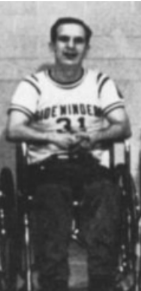
Hometown: Arnold, Maryland
In 1962 and 1963, George held every American and World record in Men’s Class IV Incomplete Swimming competition. He was a starting guard on every USA Men’s basketball team from 1961 to 1964. Those teams won 27 consecutive games over four years and were undefeated. The demonstration team that traveled to Brazil won five straight games. So, as a player in international competition, George never played on a losing USA team. In swimming, his record of :51.1 in the Men’s Class II Incomplete Breaststroke was unequalled. The :46.0 he posted in the 50 Meter Men’s Class Incomplete Freestyle in Tokyo in 1964 may still exist, if not rendered obsolete by reclassification. In national competition between 1961 and 1964, George earned eleven golds, ten of them national records, and one silver in swimming. In international competition, including the 1964 Paralympic Games in Tokyo, George garnered twelve gold, two silver and one bronze medal. All twelve gold medals were swimming World Records.
International competition was especially vexing in those days. The USA teams were consistently unfunded and undermanned. Conn’s team at Stoke Mandeville in 1961 included ten members of the Pan Am Jets and and himself as the lone Chicagoan. Their typical daily schedule: 1) 7am wake-up; 2) 8-9am work outs; 3) competition until 4 pm; 4) dinner at 5pm and 6) party from 7pm to 4am. Such a schedule was unbelievable for thirteen team members committed to a total of 44 individual events and 8 basketball games. Still, they finished all events, led the nationals in gold medals and were undefeated in both basketball brackets.
In South Africa in 1962, the USA Team was nearly expelled because the team had initiated the very first integrated basketball event since 1948. Later the team traveled 25,000 miles over a six week period to Zimbabwe and Zambia to give demonstrations and attend multiple receptions. The tour was a very rich learning experience for George, his team and the audiences they encountered.
The USA team was again undermanned at the Tokyo Paralympics even though the total number of team members increased. In every basketball game the USA fielded three players during the first half, four during the third qurter and a full five in the fourth. This allowed them to compete in all individual events, hold the opposting teams to a tie or slight lead through the third quarter and finally to eke out a win in the fourth quarter. They prevailed to win the gold medal and remain undefeated.


