



Paul Leimkuehler
Recreation/Development | 1996
1982
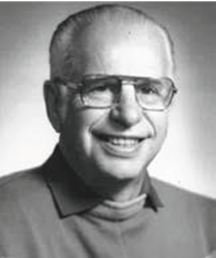
Hometown: Cleveland, Ohio
Paul Leimkuehler was very active in sports in his youth. In 1936, he competed in the U.S. Olympic Bicycle Road Race Finals in Patterson, NJ. However, life changed while serving as a Second Lieutenant and Platoon Leader in Company K of the U.S. Army’s 84th Infantry Division, also known as the “Railsplitters”. During combat in the Battle of the Bulge in the Ardennes region of Belgium, Paul was severely wounded by shrapnel and lost his left leg above the knee. For a while, he thought his days of activity were behind him. However, Paul’s life was about to take on a whole new meaning by an experience during rehabilitation. Paul involved himself on a voluntary basis in the artificial limb and brace shop while his leg was being made. In a matter of months, Paul was up and around on his own new leg and making and fitting artificial limbs to other veterans. On his release from the hospital, Paul entered the prosthetic field, quickly establishing himself as a certified fitter with a business and rose to the presidency of two national prosthetic and orthotic associations.
In 1956, Paul and his wife Kay accompanied some friends to a ski area called Seven Springs, east of Pittsburgh. Paul did not plan to ski – just take pictures of the others. However, while engaging in a conversation with a European instructor and the area manager’s son, Phil Dupre, he learned that amputees in Europe were experimenting on the ski slopes, balancing on one ski with various adaptations of crutches for balance.
He later found a short Austrian film called “Miracle on Skis”. From that, he began to design equipment of his own. He called on a war buddy who had lost the opposite leg from Paul. When they found that each had the same boot size, they shared a pair of army boots and filed a groove in the heel. Paul got hold of an old Flexible Flyer ski and fitted it with a cable binding. He saved tips off a pair of cheap kid’s skis and fitted them onto the ends of crutches with a hinging action and adjustable front and back stops which he devised. They then hit the slopes of a small hill on a local golf course. Shortly, Paul was back on the slopes learning to steer to the left in order to use the rope tow. On that day, Paul and Kay were hooked on the sport of skiing.
Later in the summer of that first year, Paul contacted Howard Head of the Head Ski Company. Head showed enthusiasm and graciously supplied Paul with two pair of metal ski tips and a pair of outrigger ski crutches. During the following season, 1957, they skied every weekend at areas in Pennsylvania, Michigan and New York. The Head Ski Company also started getting inquiries which they referred to Paul.
In 1957, the publicity reached a British army officer, Christopher Boulton, who contacted Paul. Boulton had become an amputee and discovered three-track skiing in Europe. Through him, in 1960 Paul managed to import six pairs of outrigger ski crutches from Austria. These outriggers were distributed around the country upon request and Paul was learning that amputees were not alone in their attraction to this adaptive mode. People with multiple physical disabilities were attracted. In 1958, Dick Martin, an amputee in Portland, Oregon, heard about Paul and contacted him. The result was a rendezvous of skiing at Sun Valley. Martin organized the Flying Outriggers Ski Club in Oregon. Lee Perry, a certified ski instructor and Hal Schroeder joined Martin in spreading the word to California in the early 1960s.
Paul Leimkuehler was elected to the U.S. National Ski Hall of Fame in 1981.


